Disclosure: This post contains affiliate links. If you buy through them, True North Winter may earn a commission at no extra cost to you. As an Amazon Associate I earn from qualifying purchases. Full disclosure
By The True North Winter team · Research-based roundup · Last updated October 2026
A whiteout on the 401, a closed stretch of the Trans-Canada through the Rockies, a slide into the ditch on a quiet rural road in Saskatchewan: Canadian winter driving can go sideways fast. When it does, the gear in your trunk decides whether you’re mildly inconvenienced or genuinely in trouble.
This guide gives you a practical checklist of what to pack, plus a short list of specific products sold at Canadian retailers to help you build your kit quickly. It’s a research-based roundup: we compared product listings, manufacturer specs and public safety guidance (including the Government of Canada’s Get Prepared recommendations for vehicle kits). We haven’t personally tested these items.
Quick picks
| Pick | What it covers | Where | Approx. price (CAD)* |
|---|---|---|---|
| MotoMaster CT100 Winter Safety Kit | All-in-one starter kit | Canadian Tire | $35–$50 |
| Garant 11-inch Compact Car Snow Shovel | Digging out tires and tailpipe | Home Depot Canada | $20–$30 |
| Garant Premium Telescopic Snow Brush (36–60 in.) | Clearing roof, windows and lights | Home Depot Canada | $30–$50 |
| HotHands Hand Warmers (40 pairs) | Emergency warmth | Amazon.ca | $40–$50 |
| NOCO Boost Plus GB40 | Jump-starting without another car | Amazon.ca | $130–$160 |
*Prices change often. Check the retailer for current pricing.
What to look for in Canada
Plan for being stuck, not just breaking down
In much of Canada, the realistic worst case isn’t a flat tire. It’s being stranded for hours in -20 °C or colder, sometimes with no cell signal. Your kit should help you stay warm, stay visible, get unstuck, and get help.
Think about your province and your route
- Quebec requires winter tires on passenger vehicles registered in the province from December 1 to March 15. An emergency kit is no substitute for proper tires.
- British Columbia requires winter tires (M+S or three-peak mountain snowflake) on many designated highways from October 1 to April 30 (some routes end March 31), and drivers may be required to carry chains where signs direct. Check DriveBC before mountain passes like the Coquihalla.
- Prairies and the North: long distances between towns mean extra food, water, fuel discipline and warmth matter more.
- Atlantic Canada and coastal BC: wet, heavy snow and freezing rain make a good scraper and traction aid essential.
Pack for cold-weather durability
Plastic gets brittle in deep cold, batteries drain, and liquids freeze. Choose sturdy tools, keep electronics charged, and use water bottles with room to expand (or keep water inside the cabin).
Winter car emergency kit checklist
Stay warm
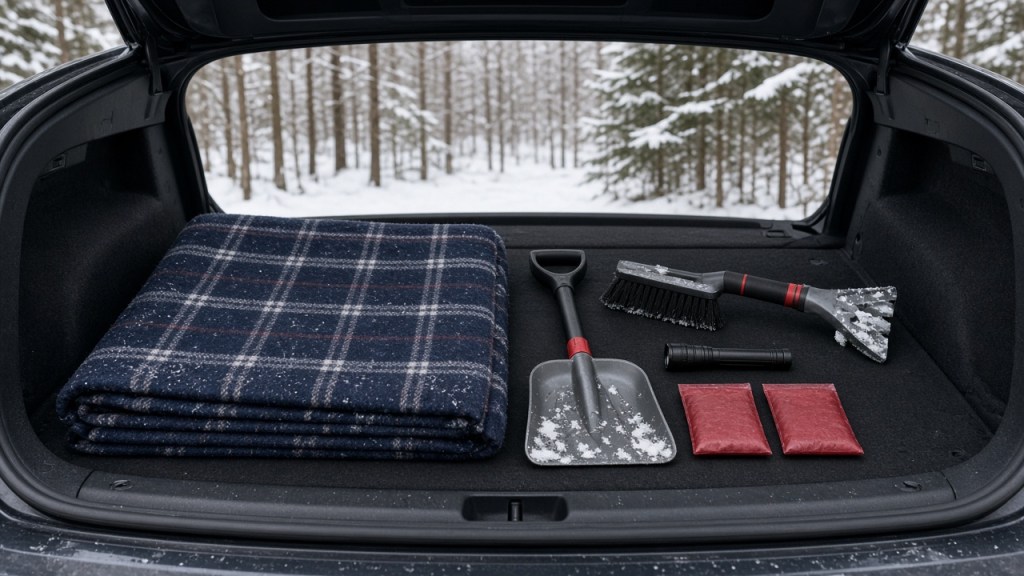
- Warm blanket or sleeping bag (one per regular passenger)
- Extra toque, mitts, socks and boots
- Hand and foot warmers
- Emergency (Mylar) blankets as a compact backup
Get unstuck
- Compact snow shovel
- Snow brush and ice scraper
- Traction aid: sand, non-clumping cat litter or traction mats
- Tow strap (used with care and only with proper attachment points)
Get going again
- Booster cables or a lithium jump starter
- Windshield washer fluid rated for winter (-40 °C)
- Basic tools and a tire gauge
Stay visible and get help
- Flashlight or headlamp with spare batteries
- Reflective triangles or road flares
- Phone charger/power bank
- Whistle
- Paper map of your region
First aid and supplies
- First aid kit
- Non-perishable, high-energy food (granola bars, nuts)
- Water (stored so it can freeze without bursting)
- Any essential medications
- Candle in a deep metal can and waterproof matches (only with a window cracked for ventilation)
Before every trip: keep your gas tank at least half full in winter, check road conditions (511 services, DriveBC, Québec 511), and tell someone your route on long drives.
The best winter emergency kit gear
1. MotoMaster CT100 Winter Safety Kit: Best all-in-one starter kit
Why it made our list: Building a kit item by item takes time. Canadian Tire’s MotoMaster winter kit bundles many of the basics in one bag, and it’s sold in stores across the country.
What’s included (per listings): a shovel, traction aid, booster cables, tow strap, headlamp, fleece blanket, knit gloves, a hat (toque), hand warmers, and a one-year Canadian Tire Roadside Assistance Emergency Plan. The plan must be activated, and coverage has limits, so read the terms.
Good fit if: you want a solid baseline you can add to (food, water, first aid kit, better scraper).
Approx. price: $35–$50 CAD; it often goes on sale (prices change).
2. Garant 11-inch Compact Car Snow Shovel: Best trunk shovel
Why it made our list: Garant is a Quebec-based tool maker, and this compact shovel is built for trunk storage and clearing snow around tires.
Key specs (per Garant/Home Depot Canada):
- 28 cm (11 in.) poly blade
- Telescopic steel handle, about 102 cm (40 in.) extended (per Garant)
- Model GP110TSKD
Good fit if: your all-in-one kit’s shovel feels flimsy, or you want a dedicated shovel that won’t take up much space.
Approx. price: $20–$30 CAD (listed at $24.98 at Home Depot Canada at time of writing; prices change).
3. Garant Premium Telescopic Snow Brush (36–60 in.): Best snow brush
Why it made our list: In many provinces, driving with snow piled on your roof or obstructed windows can get you a ticket, and it’s dangerous for drivers behind you. A telescopic brush helps you reach the middle of an SUV or truck roof.
Key specs (per Home Depot Canada listing):
- Telescopes from about 91 to 152 cm (36–60 in.)
- Foldable 43 cm (17 in.) EVA foam head
- Integrated ice scraper
Good fit if: you drive a crossover, SUV, minivan or truck.
Approx. price: $30–$50 CAD (prices change).
4. HotHands Hand Warmers (40 pairs): Best emergency warmth
Why it made our list: Air-activated warmers are cheap, compact and need no power. A bulk pack lets you stash some in every vehicle and in your snow-clearing jacket too.
Key specs (per Amazon.ca listing):
- 40 pairs (80 warmers), air-activated
- Up to 10 hours of heat, per the manufacturer
Good fit if: you want a simple warmth backup for every passenger.
Tip: check expiry dates and replace them every few seasons.
Approx. price: $40–$50 CAD on Amazon.ca (prices change).
5. NOCO Boost Plus GB40: Best jump starter for your kit
Why it made our list: Booster cables need a second vehicle. On an empty rural road at night, a charged lithium jump starter lets you get yourself going.
Key specs (per NOCO/Amazon.ca listing):
- 1,000 A peak, 12 V lithium
- Rated for gas engines up to 6.0 L, diesel up to 3.0 L
- Spark-proof, reverse-polarity protection; doubles as a USB power bank
Tip: lithium packs lose charge faster in the cold. Bring it inside on very cold nights and recharge it monthly.
Approx. price: $130–$160 CAD (prices change).
For more on boosters and block heaters, see our guide to the best block heaters and battery boosters for cold starts.
Winter emergency kit FAQ
What should I do if I get stuck in a snowstorm in my car?
General safety guidance is to stay with your vehicle (it’s shelter and easier for rescuers to spot), call for help if you have signal, keep the exhaust pipe clear of snow, run the engine only periodically for heat with a window slightly open to prevent carbon monoxide buildup, and use your hazard lights or a light inside the car to stay visible.
Is cat litter or sand better for traction?
Both can help. Sand is the traditional choice; non-clumping cat litter is a common alternative. Traction mats are reusable and less messy. Whatever you choose, keep it in a sealed container.
Should I keep water in my car in winter?
Yes, but it may freeze. Use bottles that aren’t filled to the brim, or bring water with you from the house on long trips. Avoid glass.
How often should I check my winter car kit?
At least once a year in the fall. Check flashlight batteries, charge your jump starter and power bank, replace expired food and hand warmers, and restock anything you used last winter.
Do I still need a kit if I have roadside assistance?
Yes. Roadside assistance can take hours to reach you in a big storm or remote area. Your kit keeps you warm and safe while you wait.
The bottom line
A good winter car kit doesn’t need to be expensive. Start with an all-in-one like the MotoMaster CT100 Winter Safety Kit, upgrade the essentials with a sturdy Garant shovel and telescopic snow brush, add HotHands warmers, food, water and a first aid kit, and keep a charged NOCO GB40 for the morning your battery quits. Then keep your tank half full, check the forecast and road reports, and drive for the conditions.
Print the checklist above, stash it in your glovebox, and review it every October.


Leave a Reply